

Quick Summary: Professional Golf Bag OEM Selection
The Durability Standard: In the 2026 market, “Hydrolysis Resistance” and “UV Hours” are the true metrics of quality. Partnering with a professional golf bag factory that prioritizes lab-tested microfiber PU is the only way to prevent product peeling and catastrophic brand erosion.
The Value Multiplier: Internal HDPE (High-Density Polyethylene) skeletons and high-density 3D embroidery are the primary justifications for premium MSRP. These structural and aesthetic hallmarks are what differentiate a “tour-grade” Golf Bag from a generic, low-margin imitation.
The Compliance Mandate: YKK #10 zippers, N52 magnetic closures, and Prop 65/REACH certifications are no longer “optional upgrades”—they are the baseline for global survival. Ignoring these technical and regulatory standards is the fastest route to high return rates and customs clearance failures.
The 2026 Insider’s Guide: 5 Non-Negotiable Standards for a Top-Tier Golf Bag OEM
Let’s be honest for a second. If you are reading this, you’ve likely realized that the global golf market in 2026 has shifted. It’s no longer just about having a logo on a product; it’s about the integrity of the supply chain, the technical precision of the build, and the sustainability of the materials. As someone who has spent over fifteen years on the factory floor and in the boardroom of the professional golf bag factory world, I can tell you that finding a vendor is easy. Finding a partner who understands the “why” behind every stitch? That is the real challenge.
The Golf Bag industry is currently caught between traditional craftsmanship and high-tech engineering. For B2B buyers, golf clubs, and emerging DTC brands, the stakes have never been higher. A single batch of failing zippers or a shipment of bags that peel under the Florida sun can wipe out years of brand equity. That is why I’ve put together this guide. These are the five non-negotiable standards you must demand from your OEM golf bag production partner this year.
Standard 1: Material Integrity and the 2026 Sustainability Mandate
In 2026, the word “quality” is synonymous with “durability.” When we talk about a premium golf bag supplier, the conversation must begin with the raw materials. In the past, “PU Leather” was a generic term. Today, we categorize materials by their chemical stability and environmental footprint.
Moving Beyond Basic PU: The Rise of Bio-Based Synthetics
We are seeing a massive move away from traditional solvent-based PU toward Microfiber Leather and Water-Based Polyurethane. For a custom golf bag manufacturer, offering these isn’t a luxury—it’s a requirement for the EU and North American markets. Bio-based synthetics are now reaching tensile strengths that rival genuine leather while remaining significantly lighter.
If your factory is still using low-grade PVC or traditional PU that hasn’t been tested for hydrolysis resistance, your bags will begin to peel within 18 months. A top-tier professional golf bag factory must provide materials that are REACH and RoHS compliant. These aren’t just acronyms; they are your ticket to clearing customs without a headache.
Weatherproofing and UV Resistance Standards
A Golf Bag lives outdoors. It faces 40°C heat in Dubai and humid rain in Scotland. We measure material performance in “UV Hours.” A standard bag might survive 100 hours of direct UV exposure before fading; a professional-grade bag must exceed 250 hours.
| Material Property | Entry-Level PU | Premium Microfiber | Bio-Based Synthetic (2026) |
| Tensile Strength (N/cm) | 150 – 200 | 450 – 550 | 500+ |
| UV Resistance (Hours) | 80 – 100 | 200 – 250 | 300+ |
| Hydrolysis Resistance | 1 Year | 3 – 5 Years | 5+ Years |
| Weight (g/m²) | 800 | 600 | 550 |
| Environmental Compliance | Basic | REACH/RoHS | GRS / Carbon Neutral |
Standard 2: Structural Engineering and Ergonomics
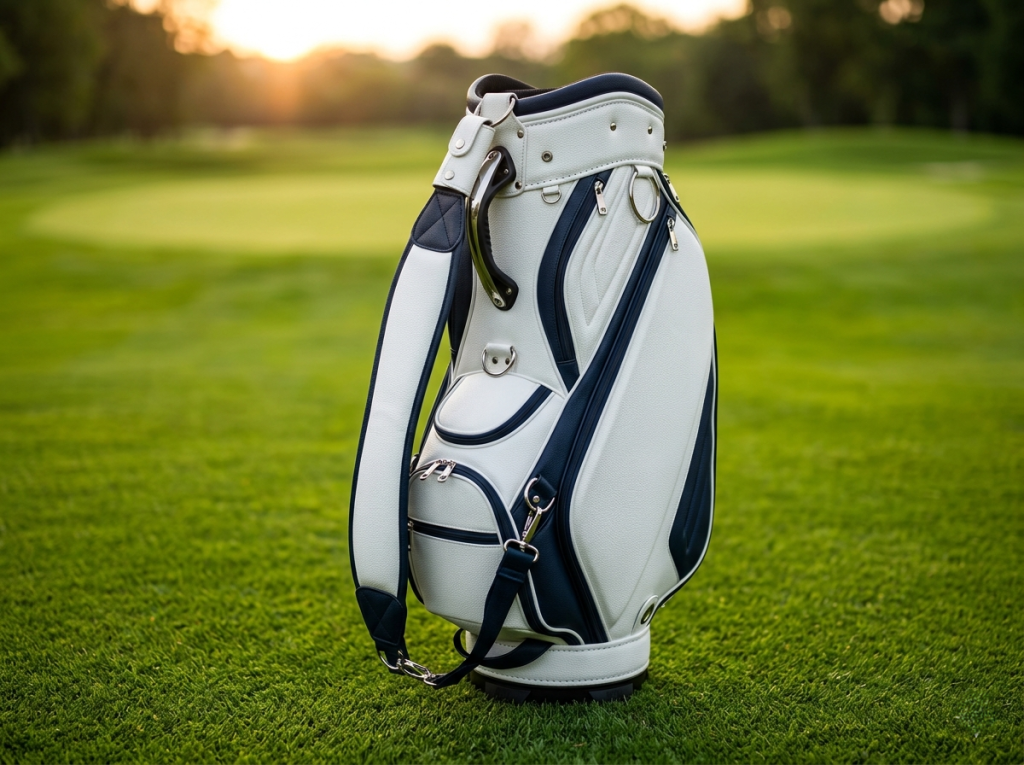
I’ve seen beautiful bags fall apart because the “skeleton” was weak. When you are sourcing wholesale golf staff bags, you aren’t just buying a container for clubs; you are buying an engineered chassis.
The Skeleton of a Tour-Grade Staff Bag
A tour-grade bag needs to hold 10kg to 15kg of equipment without deforming. A custom golf bag manufacturer with high standards will use High-Density Polyethylene (HDPE) for the internal molding. HDPE provides the rigidity needed to maintain the bag’s shape for years, whereas cheaper factories might use recycled cardboard or low-density plastics that warp under the weight of a full set of irons.
The “base” of the bag is another critical fail point. In 2026, we utilize anti-slip, high-impact rubber bases that are double-riveted to the HDPE frame. If the base isn’t secure, the bag won’t stand straight—a major pain point for golfers on the range.
Divider Systems and Club Protection
Whether it’s a 6-way or a 14-way divider, the construction matters more than the count. We now use graphite-friendly mesh and velour-lined tops. Why? Because modern golf clubs are an investment. If your professional golf bag factory is using rough nylon liners, those club shafts will have “bag wear” scratches within a month. A premium bespoke golf bag design includes full-length dividers that are sewn into the base, preventing the “club tangle” that ruins the user experience.
Standard 3: Mastery of Branding and Customization Craftsmanship
The difference between a $150 bag and a $600 bag is often found in the millimeters. When a client asks for bespoke golf bag design, they are looking for visual perfection.
Advanced Embroidery and Appliqué Techniques
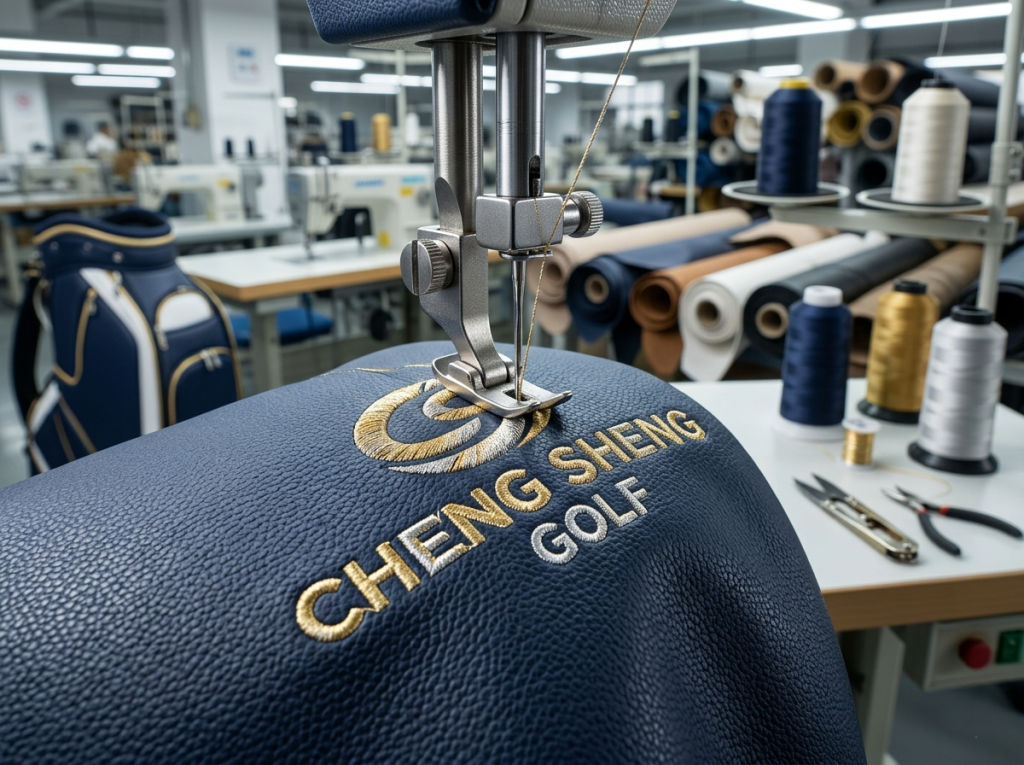
Digital embroidery has evolved. We now talk about “stitch density.” A premium golf bag supplier should be achieving 350 to 450 stitches per square inch for complex logos. This ensures the logo doesn’t “pucker” or fray over time. Furthermore, we are seeing a trend in 3D-molded silicone badges and laser-etched hardware. These small details signal to the consumer that they are carrying a piece of professional equipment.
Hardware and Component Sourcing
I tell all my clients: “Your Golf Bag is only as good as its weakest zipper.” We exclusively recommend YKK #10 zippers for the main compartments. They are the industry standard for a reason. If your OEM golf bag production partner is cutting costs on “generic” zippers, they are setting you up for a 20% return rate. In 2026, we also see the rise of magnetic pocket closures—specifically N52 neodymium magnets—which allow for silent, one-handed access during a round.
Standard 4: Supply Chain Transparency and B2B Scalability
As an experienced exporter, I know that the best product in the world is useless if it’s sitting in a warehouse three months late.
Managing Lead Times in a Volatile Global Market
A professional golf bag factory must have a robust ERP (Enterprise Resource Planning) system. You should be able to track your OEM golf bag production from the moment the fabric is dyed to the moment the last carton is loaded into the container.
The peak seasons (Q3 and Q4) are brutal. A reliable partner will have “buffer” production capacity or “Digital Twin” prototyping. Digital prototyping allows us to send you a 3D render of your custom golf bag manufacturer project before we even cut the first piece of fabric, saving weeks in the sampling phase.
Regulatory Compliance for Global Export
If you are selling in California, you need Prop 65 compliance. If you are in the EU, you need REACH. A premium golf bag supplier should have these test reports ready before you even ask for them. This level of transparency is what separates a world-class factory from a middleman.
Standard 5: The Pro-Level Quality Control Audit
Visual inspection is the bare minimum. In 2026, we use laboratory-grade testing to ensure the Golf Bag can survive the real world.
Beyond Visual Inspection: Laboratory Testing
Every batch of wholesale golf staff bags should undergo three specific tests:
-
The Salt Spray Test: We place the hardware in a salt-fog chamber for 48-72 hours. This simulates three years of use in coastal golf resorts. If the buckles rust, the batch is rejected.
-
The Handle Stress Test: We load the bag with 20kg and a machine lifts it by the handle 5,000 times. If there is a single millimeter of tear in the stitching, the reinforcement method is redesigned.
-
The Color Fastness Test: We rub the material with wet and dry cloths to ensure the dye doesn’t transfer to the golfer’s expensive white polo shirt.
The Pre-Shipment Checklist for Wholesale Buyers
Before your wholesale golf bags leave the warehouse, a final audit must occur. This includes a “Zipper Fluidness” test, an “Alignment Check” (ensuring the bag stands at a perfect 90-degree angle), and a “Seam Strength” audit. This level of QC is why premium golf bag supplier partners can offer 2 or 3-year warranties with confidence.
The Economics of Quality: Why Cheap is the Most Expensive Option
Let’s look at the numbers. A low-cost Golf Bag might save you $40 on the unit price. However, consider the “Total Cost of Ownership.”
-
Returns & Warranty Claims: A 5% failure rate on a 1,000-unit order at a $300 retail price is a $15,000 loss.
-
Brand Erosion: One bad review on a major golf forum can cost you thousands in lost future sales.
-
Shipping Inefficiencies: Cheap bags are often poorly packed, leading to “creasing” during transit that cannot be steamed out.
When you work with a professional golf bag factory, you are paying for the peace of mind that the landed product will be exactly what you promised your customers.
2026-2027 Trend Forecast: What’s Next for the Golf Bag Industry?
As we look toward 2027, the bespoke golf bag design world is moving toward “Smart Tech” integration. We are already developing bags with integrated, solar-charging panels for GPS devices and hidden pockets for Apple AirTags or similar trackers.
There is also a shift toward “Minimalist Luxury.” The loud, over-branded bags of the 2010s are being replaced by clean lines, matte finishes, and tonal embroidery. Brands that want to capture the younger, affluent demographic are seeking private label golf bags that feel like high-end fashion pieces but perform like athletic gear.
Conclusion: Choosing Your Partner for the Long Game
In the world of international trade, the “Long Game” is the only game that matters. Whether you are looking for wholesale golf staff bags for a tournament or building a brand from scratch as a custom golf bag manufacturer, your choice of factory is your most important business decision.
Don’t just look at the catalog. Ask for the lab reports. Ask about the HDPE frame. Ask about the UV resistance of the PU leather. A truly professional golf bag factory will be excited to answer those questions because it proves they have nothing to hide.
FAQ: Common Questions from Overseas Golf Bag Buyers
1. What is the typical MOQ for a custom golf bag manufacturer in 2026?
Most professional golf bag factory setups require a Minimum Order Quantity (MOQ) of 50 to 100 units per colorway for high-end staff bags. For more complex OEM golf bag production involving custom-molded parts or unique fabric dyes, the MOQ may increase to 200 units. However, many suppliers offer “tiered” MOQ programs for emerging brands looking to scale.
2. How long does the production lead time take for wholesale golf staff bags?
Typically, the sampling phase takes 2-3 weeks. Once the sample is approved, the mass production of wholesale golf staff bags generally takes 45 to 60 days, depending on the complexity of the bespoke golf bag design and the factory’s current queue. It is always advisable to book your Q4 production slots by late Q2 to avoid the “holiday rush” delays.
3. Can a premium golf bag supplier provide REACH and Prop 65 certification?
Yes, any premium golf bag supplier worth their salt should be able to provide third-party lab certifications (such as SGS or Intertek) for REACH, RoHS, and California Proposition 65. These certifications ensure that the materials used in your Golf Bag are free from harmful lead, phthalates, and other restricted chemicals, which is crucial for legal sale in the US and EU.
4. What are the best materials for a durable, weather-resistant Golf Bag?
For 2026, the gold standard is Microfiber PU leather. It offers superior durability and weather resistance compared to traditional PVC or bonded leather. When sourcing from a professional golf bag factory, ensure the material has a hydrostatic head rating (waterproofing) of at least 5,000mm and a UV color fastness rating of Grade 4 or higher to prevent fading in sunny climates.
5. How do you handle quality control for large wholesale golf bags orders?
A professional custom golf bag manufacturer utilizes a multi-stage QC process: Initial Material Inspection (IQC), In-Process Quality Control (IPQC) during stitching and assembly, and a Final Quality Audit (FQA) based on AQL 2.5 standards. This includes stress testing the handles, checking zipper longevity, and ensuring the structural integrity of the HDPE internal frame before the Golf Bag is packed for shipment.
[Contact our engineering team today to review your tech pack and plan your all-weather collection.]
Post time: Mar-30-2026