

Health Impact: Carrying a heavy bag can cause up to 6mm of spinal shrinkage per round and increases metabolic energy consumption by 15-20%, leading to fatigue that harms your swing.
Travel Smart: Airlines typically have a 50 lb weight limit for golf bags. New ESTA mobile app features for 2025-2026 simplify US entry for international golf travelers.
The Solution: Modern manufacturing from leaders like Chengsheng Golf utilizes aerospace-grade materials to reduce weight without sacrificing durability, offering the perfect balance for the walking golfer.
1. Introduction: The Weight of the Game
1.1 A Conversation on the First Tee
The morning mist still clings to the fairway as two golfers, Mark (a seasoned club professional) and Sarah (an enthusiastic amateur), stand by the trunk of a car, debating equipment choices.
Mark: “You’re looking at that Tour bag like it’s an anchor, Sarah. Are you sure you want to commit to hauling that beast for 18 holes?”
Sarah: “I just love how it looks—it makes me feel like a pro. But honestly, Mark, just lifting it out of the car was a workout. I didn’t think an empty bag would feel this heavy. How much does a golf bag weigh, typically? This feels like lead.”
Mark: “That’s the most common trap in golf equipment. What you have there is a Staff bag. Empty, it’s already pushing 12 pounds. By the time you load your 14 clubs, a dozen balls, your rain gear, and water, you’re going to be carrying over 30 pounds. The pros have caddies for that. If you’re walking, you need efficiency, not bulk.”
Sarah: “Thirty pounds? I guessed maybe fifteen. That explains why my back was killing me by the 14th hole last week.”
Mark: “Exactly. It’s simple physics. Every pound you carry is energy diverted away from your swing mechanics. I’ve been testing some new prototypes from Chengsheng Golf recently. They have stand bags engineered with high-tensile nylon that weigh under 5 pounds but still have full structural integrity. It’s night and day. Switching to something like that would save you the equivalent of carrying three bowling balls around the course.”
Sarah: “Three bowling balls? When you put it that way, the ‘pro look’ doesn’t seem worth the back pain. So, if I swap to a lightweight stand bag, what’s the realistic saving?”
Mark: “You’d drop about 7 to 8 pounds instantly. In terms of biomechanics, that reduction prevents millimeters of spinal compression over a four-mile walk. It’s not just about comfort; it’s about longevity in the sport.”
1.2 The Evolution of Load-Bearing in Golf
The question “how much does a golf bag weigh?” is not merely a query about specifications; it is an inquiry into the intersection of athletic performance, material engineering, and human physiology. Historically, golf bags were unstructured canvas or leather sacks, heavy and cumbersome, designed solely for utility with no regard for ergonomics. As the game evolved into a global sport of precision, the equipment carrying that precision had to evolve concurrently.
Today, the golf bag industry is a battleground of innovation. Manufacturers strive to shave ounces while increasing durability, utilizing materials borrowed from the aerospace and hiking industries. At the forefront of this evolution are manufacturers like Chengsheng Golf (Xiamen Cheng Sheng Bags Co., Ltd.), whose expertise in OEM (Original Equipment Manufacturer) and ODM (Original Design Manufacturer) production has set new standards for weight-to-strength ratios.
This report provides a comprehensive examination of golf bag weight. We will dissect the mass of various bag categories, analyze the “hidden” weight of accessories, explore the medical implications of carrying a loaded bag, and discuss the logistical challenges of international travel—including recent updates to US entry requirements via ESTA. Through this lens, we reveal how proper equipment selection, specifically from leaders like Chengsheng Golf, can enhance both the enjoyment and the longevity of a golfer’s career.
2. Categorical Weight Analysis: The Hierarchy of Mass
To understand weight dynamics, one must first categorize the vessel. The generic term “golf bag” encompasses a spectrum of designs ranging from minimalist sleeves to massive mobile lockers. The weight variance between these categories can exceed 400%, a disparity that fundamentally alters the biomechanical demands placed on the player.
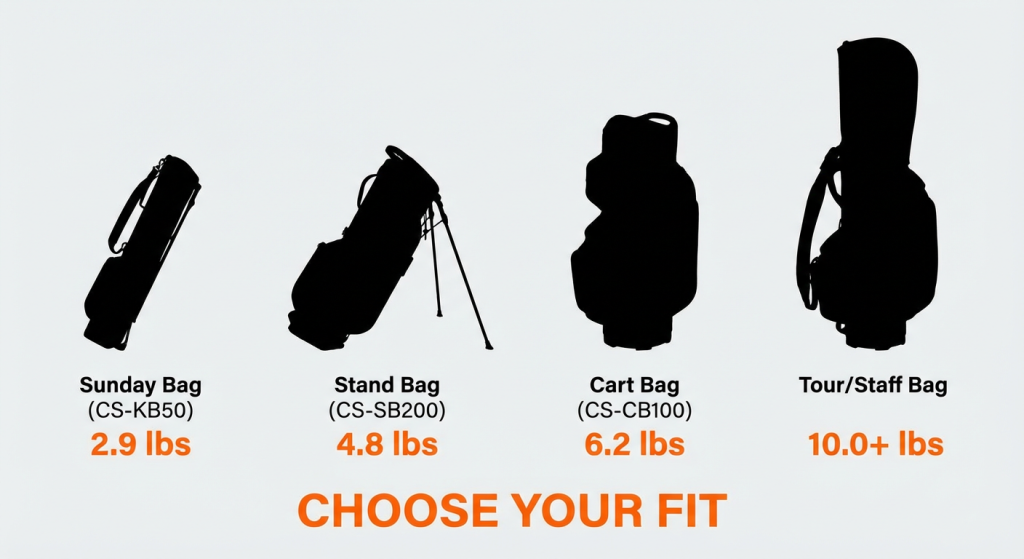
Golf bag weight comparison chart showing Sunday, Stand, Cart, and Tour bag mass in lbs
2.1 The Sunday and Pencil Bag (The Ultralights)
The “Sunday bag” traces its lineage to an era when caddies were unavailable on Sundays, forcing players to carry their own clubs. Consequently, these bags represent the absolute floor of weight potential.
-
Weight Specifications: These bags typically weigh between 1.5 lbs and 3.0 lbs (0.7 kg – 1.4 kg).1
-
Structural Design: To achieve this featherweight status, all non-essential components are stripped away. There are no rigid spines, no mechanical stand legs, and minimal padding. The material is often a single layer of nylon or polyester.
-
Use Case: They are ideal for practice sessions, par-3 courses, or travel where weight restrictions are draconian.
-
Chengsheng Golf Benchmark: The CS-KB50 Carry Bag is a prime exemplar of this category. Weighing in at approximately 2.9 lbs, it features a soft-structure design that can accommodate a partial or full set of clubs without the bulk of a rigid frame. For the golfer prioritizing absolute minimalism, this represents the pinnacle of weight efficiency.3
2.2 The Stand Bag (The Walker’s Standard)
The stand bag is the most versatile and popular category for the walking golfer. Its defining feature—retractable legs that deploy when the bag is set down—adds mechanical complexity and weight but provides essential utility by keeping clubs off wet turf.
-
Weight Specifications: The industry standard for a modern stand bag falls between 3.0 lbs and 7.0 lbs (1.4 kg – 3.2 kg).
-
The “Lightweight” Threshold: A stand bag under 4 lbs is generally considered “ultralight,” often achieving this by using carbon fiber legs and lighter denier fabrics. Bags between 4 and 6 lbs usually offer more durable zippers, more pockets, and thicker strap padding.
-
Chengsheng Golf Benchmark: The CS-SB200 Stand Bag sits in the optimal “Goldilocks” zone at 4.8 lbs. This weight is deliberate. While it is possible to make a bag lighter, doing so often compromises the durability of the leg mechanism or the water resistance of the fabric. At 4.8 lbs, the CS-SB200 offers a robust 5-way or 14-way divider top and a stable base, ensuring the bag does not topple in the wind—a common failure point of sub-3lb stand bags.3
2.3 The Cart Bag (The Rider’s Choice)
Designed specifically to be strapped onto a riding cart or a push trolley, cart bags sacrifice portability for capacity. They are rarely carried for more than the distance from the trunk to the bag drop.
-
Weight Specifications: Cart bags generally range from 5.0 lbs to 10.0 lbs (2.3 kg – 4.5 kg).
-
Structural Differences: Unlike stand bags, cart bags are engineered with a single-facing pocket layout, allowing access to all compartments while the bag is strapped in. They often feature a fully rigid internal tube construction to prevent crushing when strapped tightly to a cart.
-
Chengsheng Golf Benchmark: The CS-CB100 Cart Bag weighs approximately 6.2 lbs. This is remarkably light for its class, achieved through Chengsheng’s advanced material sourcing which substitutes heavy PVC piping with lighter, high-strength polymer composites for the internal structure. This allows the golfer to enjoy the storage benefits of a cart bag without the penalty of hoisting a heavy object in and out of a vehicle.3
2.4 The Tour / Staff Bag (The Heavyweights)
The Staff bag is a marketing tool first and a piece of equipment second. These are the massive, billboard-style bags seen on the PGA and LPGA Tours.
-
Weight Specifications: Empty, these bags weigh between 10 lbs and 15 lbs+ (4.5 kg – 7 kg+).4
-
Why They Are Heavy: They are constructed from thick synthetic leather (PU) or genuine leather, heavy metal hardware, and massive steel-ring reinforcements. The priority is durability and visual presence, not weight savings.
-
The Pro vs. Amateur Reality: Amateurs often purchase these bags to emulate their idols, failing to realize that professionals never carry them. A caddie carries the bag. For a solo amateur, a Staff bag is a logistical burden that contributes significantly to fatigue and handling injuries.
Table 1: Comprehensive Weight Comparison by Category
| Bag Category | Weight Range (lbs) | Weight Range (kg) | Primary Material | Ideal User Profile | Chengsheng Model |
| Sunday / Pencil | 1.5 – 3.0 | 0.7 – 1.4 | Nylon / Polyester | Minimalist Walker | CS-KB50 (2.9 lbs) |
| Stand / Carry | 3.0 – 7.0 | 1.4 – 3.2 | Nylon / Carbon Legs | 18-Hole Walker | CS-SB200 (4.8 lbs) |
| Cart Bag | 5.0 – 10.0 | 2.3 – 4.5 | Polymer / PU | Cart Rider / Push Cart | CS-CB100 (6.2 lbs) |
| Tour / Staff | 10.0 – 15.0+ | 4.5 – 7.0+ | Leather / Heavy PU | Professional / Collector | Custom OEM |
3. The “Full Load” Equation: What Actually Goes Inside?
The “empty weight” of a golf bag is a marketing metric; the “gross weight” is the physical reality. To fully answer “how much does a golf bag weigh,” we must audit the contents of the typical golfer’s arsenal.
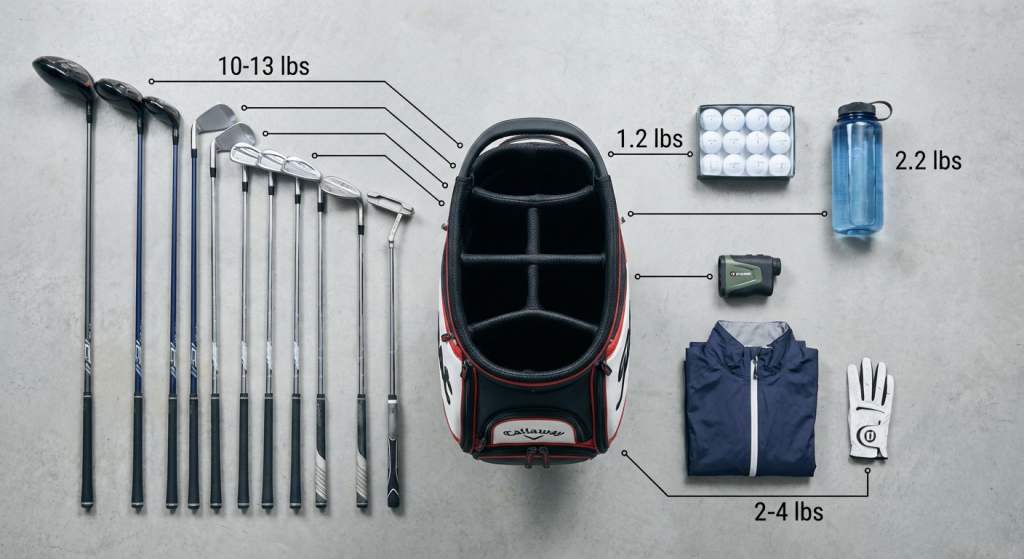
Exploded view of golf bag contents and weight of clubs balls and accessories
3.1 The Iron and the Wood: Club Mass
The set of 14 clubs constitutes the single largest mass component.
-
Total Set Weight: A standard set of 14 clubs weighs between 10 and 13 lbs (4.5 – 6 kg).
-
Shaft Variable: The choice of shaft material significantly impacts total weight. A set of irons with steel shafts can weigh 2-3 lbs more than an identical set with graphite shafts.
-
Steel Shaft: ~110-130 grams per shaft.
-
Graphite Shaft: ~50-80 grams per shaft.
-
-
Grip Weight: Often overlooked, midsize or jumbo grips add approximately 10-20 grams per club, amounting to nearly half a pound across a full set.
3.2 The Hidden Density of Accessories
It is the accumulation of “small” items that often pushes a manageable bag into the danger zone of weight.
-
Golf Balls: A single golf ball weighs ~1.62 ounces (46 grams). A standard box of 12 weighs 1.2 lbs (0.5 kg). High-handicap players carrying 24 balls are adding 2.5 lbs of dead weight—equivalent to carrying an extra pair of shoes.
-
Hydration: Water is heavy. A standard 1-liter water bottle adds 2.2 lbs (1 kg). While essential for hydration, carrying a full liter from the first tee is a strategic error if water stations are available on the course.
-
Apparel: Rain suits, windbreakers, and extra layers can add 2-4 lbs depending on the material (Gore-Tex vs. standard nylon).
-
Tech: Rangefinders (0.5 lbs), GPS units, and spare batteries contribute to the total.
-
The “Junk” Factor: Many golfers unwittingly carry accumulated debris—broken tees, old scorecards, loose change, and lost balls found weeks ago. Audits of amateur bags often reveal 1-2 lbs of completely unnecessary trash.
3.3 The Total System Weight Calculation
Let us calculate the reality for two distinct golfer profiles: the Efficient Walker and the Overloaded Amateur.
Profile A: The Efficient Walker (Using Chengsheng CS-SB200)
-
Bag: 4.8 lbs
-
Clubs (Graphite): 10.0 lbs
-
Balls (6): 0.6 lbs
-
Water (0.5L): 1.1 lbs
-
Essentials (Tees, Glove, Rangefinder): 1.0 lbs
-
Total Weight: 17.5 lbs
-
Verdict: This load is manageable for a healthy adult to carry for 4 hours without significant orthopedic risk.
Profile B: The Overloaded Amateur (Using Tour Bag)
-
Bag: 12.0 lbs
-
Clubs (Steel): 13.0 lbs
-
Balls (24): 2.5 lbs
-
Water (1L): 2.2 lbs
-
Rain Gear + Umbrella: 3.5 lbs
-
Essentials + “Junk”: 2.0 lbs
-
Total Weight: 35.2 lbs
-
Verdict: This load exceeds 35 pounds. For a 180 lb male, this represents nearly 20% of body weight, a threshold associated with rapid fatigue and increased injury risk.
4. Physiological Impacts: The Science of Carrying
The debate over carrying versus using a pushcart is settled by biomechanics. While carrying burns more calories, it imposes specific physiological costs that must be understood.
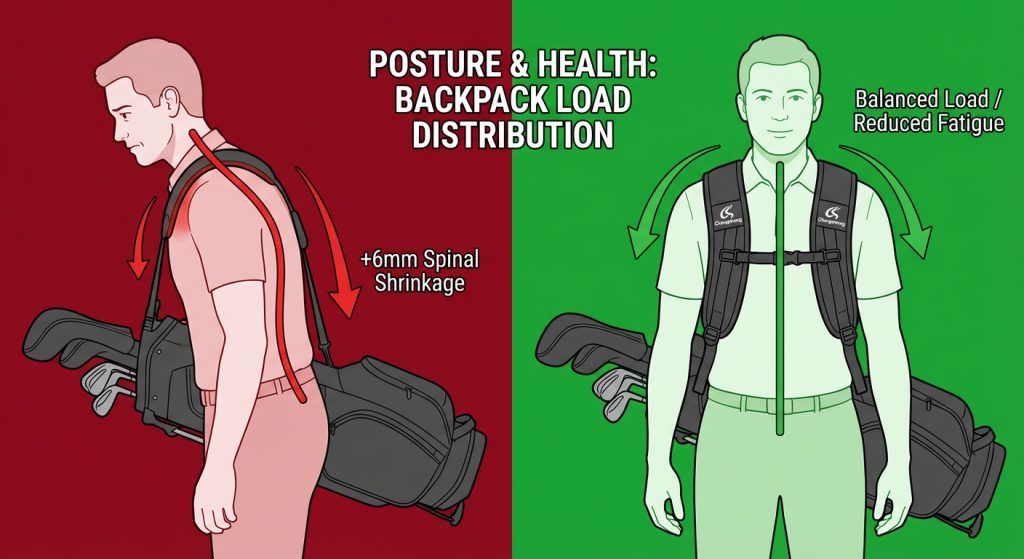
Biomechanical diagram comparing single strap vs dual strap golf bag spinal pressure
4.1 Spinal Shrinkage and Compressive Load
The human spine is a shock absorber. Under load, the intervertebral discs compress, expelling fluid and reducing disc height—a phenomenon known as “spinal shrinkage.”
-
Research Findings: A pivotal study demonstrated that carrying a golf bag weighing approximately 17.6 lbs (8 kg) over a simulated 9-hole round caused the spine to shrink by an average of 6 millimeters.
-
Comparative Analysis: In contrast, walking the same distance without a bag resulted in only roughly 4 mm of shrinkage. The additional 2 mm represents significant axial loading. While 2 mm sounds negligible, it reflects a reduction in the cushioning capacity of the discs.
-
Rotation Risk: The golf swing involves high-velocity rotation. Swinging with compressed discs—which have reduced hydrostatic pressure—increases the risk of shear injury to the lumbar spine.6
4.2 Metabolic Energy Expenditure
Carrying a bag is metabolically expensive.
-
Oxygen Consumption: Research indicates that carrying clubs requires approximately 15-20% more oxygen consumption (VO2) than walking without them. This increased demand forces the cardiovascular system to work harder, elevating heart rate.
-
The Fatigue Threshold: As the round progresses, this metabolic cost accumulates. By the 15th hole, a golfer carrying a heavy bag may experience “central fatigue,” where the nervous system reduces neural drive to the muscles, leading to loss of fine motor control—disastrous for the golf swing.
-
Dual-Strap Efficacy: Biomechanical studies confirm that dual-strap systems (standard on Chengsheng stand bags) significantly reduce perceived exertion and heart rate compared to single-strap carry methods. Symmetrical loading prevents the “lateral scoliosis” posture required to balance a single strap, keeping the spine neutral.7
4.3 Musculoskeletal Injury Correlations
-
Epidemiology: Golfers who carry their bags regularly report higher incidences of lower back pain (LBP), shoulder tendonitis, and ankle sprains compared to those who use pushcarts.
-
The “Pickup” Moment: A critical and often overlooked risk factor is the act of lifting the bag from the ground. A golfer does this 50 to 60 times per round. Improper lifting mechanics (bending at the waist rather than the knees) while fatigued is a primary mechanism for acute lumbar strain.8
5. Material Science: The Chengsheng Golf Advantage
How does a manufacturer reduce weight without sacrificing strength? The answer lies in the meticulous application of material science. Chengsheng Golf, with over two decades of manufacturing expertise and a massive 17,000-bag monthly capacity, exemplifies this engineering approach.
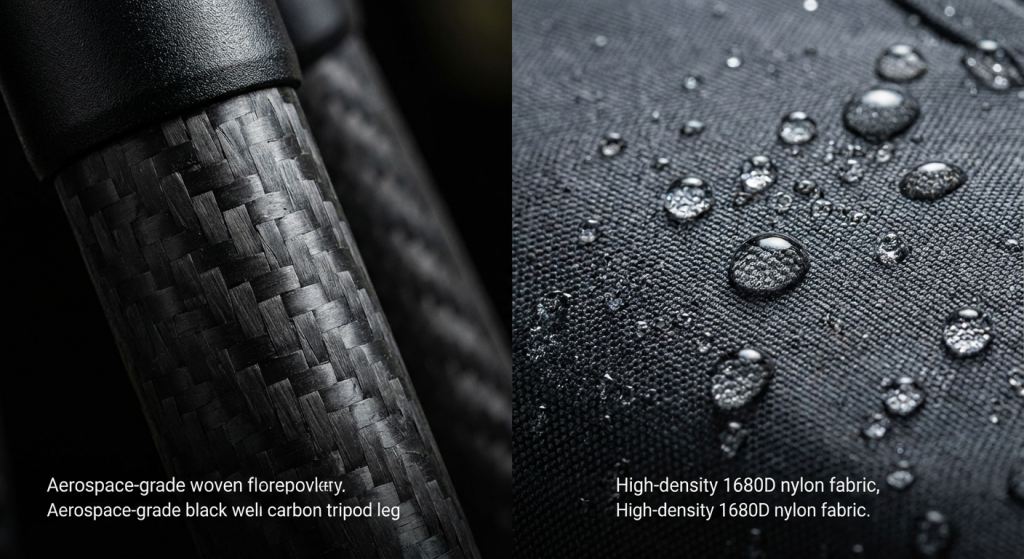
Close-up of Chengsheng Golf carbon fiber legs and waterproof nylon fabric texture
5.1 Fabric Denier and Tensile Strength
The primary weight driver in a bag’s chassis is the fabric.
-
Denier (D): This unit measures the linear mass density of fibers.
-
1680D Ballistic Nylon: Extremely heavy and durable. Used in military gear.
-
600D Polyester: Lightweight and sufficient for general use.
-
70D Ripstop: Ultralight (tent material).
-
-
Strategic Mapping: Chengsheng engineers do not use one fabric for the whole bag. They employ strategic mapping. High-wear areas (the base, the top cuff, and pocket openings) are reinforced with 1680D or 1200D fabrics for abrasion resistance. Low-stress panels (side pockets, rain hoods) utilize lighter 600D or even 210D materials. This hybrid approach sheds ounces where durability is not compromised.3
5.2 Polymer Engineering vs. Metal
Traditional bags used steel rings to maintain the bag’s cylindrical shape.
-
The Chengsheng Innovation: Modern Chengsheng bags utilize high-modulus polymer composites for the top cuff and base. These injection-molded parts are significantly lighter than their metal-reinforced predecessors but possess high impact resistance.
-
Leg Mechanisms: For stand bags, the transition from aluminum legs to carbon fiber or hollow-core composite legs has reduced the stand mechanism weight by nearly 40%. The Chengsheng CS-SB200 utilizes a proprietary leg composition that flexes under stress rather than snapping, maintaining stability at a fraction of the weight of steel.3
5.3 OEM/ODM Capabilities
Chengsheng’s role as a major OEM/ODM supplier allows them to leverage economies of scale in material sourcing. Their access to premium lightweight textiles and hardware (like YKK ultralight zippers) ensures that even their standard “white label” bags perform at a level comparable to major global brands. Their 10 production lines allow for rapid prototyping, enabling them to test and refine weight-saving concepts faster than smaller boutique manufacturers.10
6. International Golf Travel: Logistics, Law, and ESTA
For the global golfer, the weight of the bag is also a financial and legal consideration. Traveling with golf clubs introduces a complex layer of airline regulations and border entry requirements.
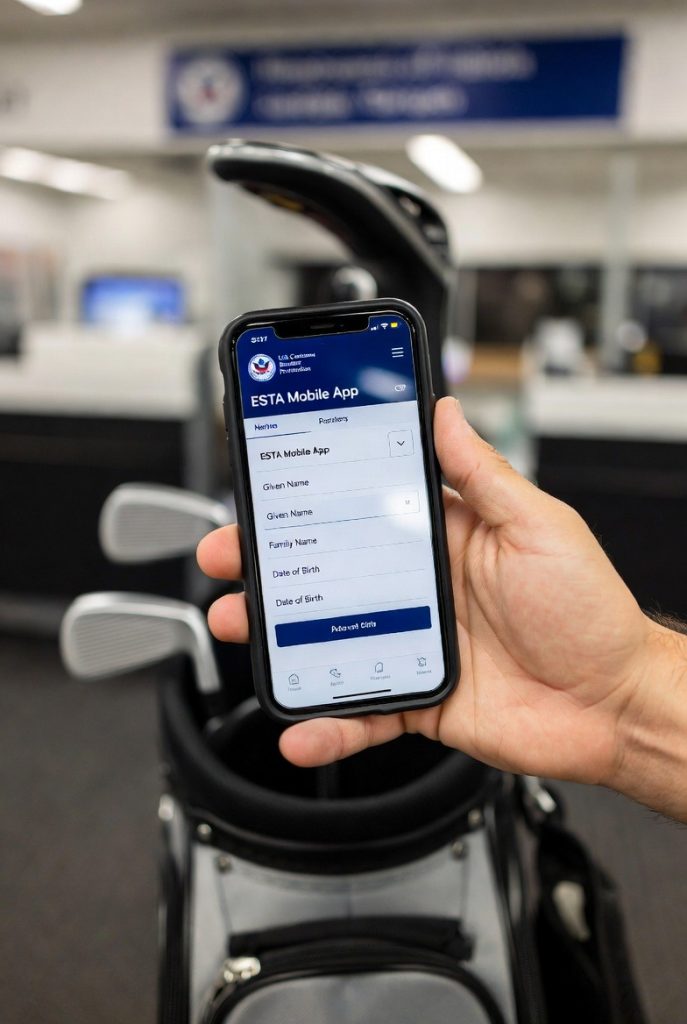
Person using ESTA Mobile App for US travel with a golf travel bag in background
6.1 Airline Regulations: The 50-Pound Barrier
Airlines have a binary view of luggage: under 50 lbs or over 50 lbs.
-
Standard Policy: Most major carriers (Delta, United, American) accept golf bags as standard checked luggage if they weigh under 50 lbs (23 kg).
-
The Cost of Overweight: Exceeding 50 lbs triggers punitive fees, often ranging from $100 to $200 per flight leg.
-
The Travel Case Factor: A hard-shell travel case (essential for protecting clubs) weighs 12-18 lbs.
-
Math: 15 lb case + 25 lb loaded bag = 40 lbs.
-
Buffer: This leaves 10 lbs for packing clothes around the clubs.
-
Risk: If the golfer starts with a 12 lb Tour bag instead of a 5 lb Chengsheng bag, the base weight jumps to 47 lbs. The buffer disappears, and the risk of overweight fees becomes a certainty.12
-
-
Oversize Waivers: Airlines like United and Delta generally waive the “oversize” (linear inch) fees for golf bags, recognizing their shape, but they rarely waive the weight fee.
6.2 Navigating US Entry: ESTA News (2025-2026)
For international golfers planning to visit the United States—perhaps to play iconic courses like Pebble Beach or attend the 2026 World Cup events—understanding the Electronic System for Travel Authorization (ESTA) is as vital as weighing their bag.
-
The New ESTA Mobile App: In a significant modernization effort, US Customs and Border Protection (CBP) has launched an ESTA Mobile App (available on iOS and Android). This tool is a boon for travelers. It allows users to scan their passport bio-page directly with their phone and take a live “liveness” selfie to verify identity, streamlining the application process significantly.14
-
Voluntary Exit Reporting: A pilot program for 2025/2026 allows VWP (Visa Waiver Program) travelers to use the app for voluntary departure reporting. By geolocating themselves at the airport upon exit, golfers can create a verified digital trail of their compliance with US immigration laws. This is particularly useful for frequent travelers who want to ensure their record remains pristine for future golf trips.16
-
World Cup 2026 Implications: With the US co-hosting the World Cup, travel volumes will spike. Golfers combining match viewing with tee times should apply for ESTA well in advance (at least 72 hours) to avoid system backlogs.18
7. Chengsheng Golf: Case Studies in Performance
The theoretical benefits of lightweight bags are best understood through practical application.
7.1 Case Study: The Professional’s Choice
Professional golfer Mark Reynolds switched to a Chengsheng-manufactured OEM bag after struggling with equipment management.
-
Problem: Disorganization and fatigue during practice rounds.
-
Solution: Adoption of a Chengsheng lightweight stand bag with a 14-way divider.
-
Outcome: “I used to waste time searching for the right club,” Reynolds noted. “With this bag, everything has its place. It’s made a noticeable difference in my game.”
-
Analysis: While Reynolds highlights organization, the underlying advantage is the reduction of cognitive and physical load. The bag’s intuitive layout and low mass allow the player to focus entirely on the shot, not the struggle of equipment management.20
7.2 Manufacturing Consistency
With a factory area spanning thousands of square meters and a workforce of professional artisans, Chengsheng ensures that the weight specifications listed are the weight specifications delivered. In an industry where “tolerance” can sometimes mean a 10% variance, Chengsheng’s rigorous QA processes ensure that a CS-SB200 rated at 4.8 lbs does not arrive weighing 5.5 lbs—a critical reliability factor for OEM clients planning shipping logistics and retail specs.10
8. Conclusion: The Lightness of Being
So, how much does a golf bag weigh?
The answer is a reflection of the golfer’s intent.
-
For the minimalist, it weighs 2.9 lbs (Chengsheng CS-KB50).
-
For the strategic walker, it weighs 4.8 lbs (Chengsheng CS-SB200).
-
For the rider, it weighs 6.2 lbs (Chengsheng CS-CB100).
-
For the uninformed, it weighs 12 lbs+ (Staff Bag).
The data is clear: weight matters. It impacts spinal health, metabolic efficiency, swing mechanics, and travel costs. The era of the heavy leather bag is over. The modern game demands the engineering prowess of companies like Chengsheng Golf, who have democratized access to tour-level lightweight materials.
As you stand on the first tee, preparing for a four-hour journey across the links, remember that the most important equipment choice you made might not be the driver in your hand, but the bag on your back. Choose lightly.
9. FAQ: Frequently Asked Questions
Q1: What is the ideal weight for a carry bag?
A: The ideal weight for a carry bag is between 3 and 5 pounds. Bags in this range, like the Chengsheng CS-SB200 (4.8 lbs), offer the best balance of structural integrity (sturdy legs, good dividers) and weight savings to prevent back fatigue.
Q2: How much does a full set of golf clubs weigh?
A: A standard set of 14 clubs typically weighs between 10 and 13 pounds (4.5 – 6 kg). Steel-shafted irons will make the set heavier (closer to 13 lbs), while graphite shafts will keep it lighter (closer to 10-11 lbs).
Q3: Why are Tour/Staff bags so heavy?
A: Staff bags are designed for durability and advertising visibility, not for carrying. They use heavy materials like synthetic leather, steel rings, and large metal hardware. They are meant to be carried by professional caddies, not the player.
Q4: Does carrying a golf bag burn more calories?
A: Yes. Carrying a golf bag burns significantly more calories than riding in a cart—roughly 721 calories for 9 holes carried vs. 411 riding. However, it also increases metabolic fatigue and heart rate, which can affect swing precision if the bag is too heavy.
Q5: What is the new ESTA mobile app for US travel?
A: The ESTA Mobile App is a new tool from US Customs and Border Protection that allows travelers from Visa Waiver Program countries to apply for travel authorization via their smartphone. It features passport scanning and live selfie verification, making it easier for international golfers to visit the US.
Q6: Can I bring my golf bag on a plane without extra fees?
A: Generally, yes, provided the bag (including the travel case) weighs under 50 lbs (23 kg). Most major airlines count a golf bag as a standard checked bag. If it exceeds 50 lbs, you will likely be charged an overweight fee.
Q7: Where can I buy Chengsheng Golf bags?
A: Chengsheng Golf primarily operates as an OEM/ODM manufacturer for global brands, but they also supply wholesale. You can find their products through various international distributors or contact them directly via their website for bulk or custom orders.
Post time: Jan-08-2026