

Introduction: A Message from the Factory Floor
In my fifteen years working the front lines at Chengsheng Golf Co., Ltd., I have sat through thousands of meetings with brand owners, distributors, and sourcing agents. Whether it is a startup brand from California or an established wholesaler from London, the conversation almost always hits a crossroads when we start talking about materials. Everyone wants the “best,” but in the world of Golf Stand Bags, “best” is subjective. It depends on your price point, your target demographic, and how you want your brand to be perceived on the green.
Choosing between nylon and PU leather is not just a technical decision; it is a strategic business move. As a veteran salesperson at a golf bag factory from China, I have seen brands skyrocket because they chose a lightweight nylon that resonated with walking golfers, and I have seen others dominate the gift market with premium PU leather. This guide is designed to strip away the marketing fluff and give you the raw, “dry goods” facts from a manufacturing perspective. We are going to dive deep into the denier counts, the chemical stability of synthetics, and the actual cost implications for your next OEM golf bag production run.
The Current Landscape of the Global Golf Bag Market
The global golf equipment market has undergone a massive shift over the last five years. We are seeing a move away from the massive, heavy staff bags used by pros toward versatile, lightweight Golf Stand Bags. Why? Because the modern golfer is more active. In markets like the United States and the United Kingdom, there is a renewed “walking culture” on the course. This shift has placed a premium on weight and ergonomics.
For a brand owner, this means your selection of a custom golf bag manufacturer is more critical than ever. You need a partner who understands that a bag is not just a container for clubs; it is a piece of performance gear. Currently, the market is split. Nylon dominates the high-volume, performance-oriented segment, while PU leather (and increasingly, high-end microfiber) captures the luxury and “pro-sumer” segments. Understanding where your brand fits in this spectrum is the first step toward a successful wholesale golf stand bags order.
Deep Dive into Nylon: The Versatile Workhorse
When we talk about nylon in our factory, we are usually referring to high-tenacity industrial fabrics. Nylon is a polymer that can be woven into various densities, measured in “Denier” (D). For Golf Stand Bags, the most common specs we use are 1680D, 900D, and 420D.
The Science of Denier: Why 1680D Nylon is a Beast
The term “Denier” refers to the linear mass density of the fiber. Specifically, it is the weight in grams of 9,000 meters of the yarn. As a custom golf bag manufacturer, we often recommend 1680D (Double-Strand) Ballistic Nylon for the high-wear areas of a bag. It was originally developed for military flak jackets, which tells you everything you need to know about its durability. It has incredible tensile strength and is nearly impossible to tear under normal golfing conditions. If your brand promises “rugged durability,” this is your material.
Why Walking Golfers Swear by Nylon
The biggest enemy of a walking golfer is weight. A typical 14-way Golf Stand Bags made of PU leather might weigh 5.5 to 6.5 lbs (2.5 to 3 kg). A similar bag made of high-grade 420D ripstop nylon can be brought down to under 4 lbs (1.8 kg). In the factory, we focus on the “carry experience.” Nylon allows us to integrate more padded strap systems and ergonomic hip pads without ballooning the total weight of the wholesale golf stand bags shipment.
Color Vibrancy and UV Resistance
Nylon takes dye exceptionally well. If your brand uses bright, neon, or highly specific Pantone colors, nylon is often the better choice. However, as an experienced golf bag factory from China, we always remind our clients about UV stabilizers. Nylon can fade if exposed to harsh sunlight for 300+ days a year. We combat this by using UV-rated coatings that ensure your bags look as good in year three as they did on day one.
The Elegance of PU Leather: The Premium Aesthetic
PU (Polyurethane) leather has come a long way from the “cheap plastic” feel of the 1990s. Modern synthetic leathers used in OEM golf bag production are sophisticated, multi-layered materials that mimic the grain, touch, and even the smell of genuine cowhide.
Water Resistance and Easy Maintenance
One of the strongest selling points for PU Golf Stand Bags is their “wipe-clean” nature. Nylon is porous; if a golfer spills a sports drink or gets mud on it, the stain can settle into the weave. PU leather is non-porous. For golfers in rainy climates or those who play on muddy courses, the ability to clean the bag with a damp cloth is a major luxury. This ease of maintenance is a key reason why premium brands continue to request PU for their wholesale golf stand bags catalogs.
The Professional Look for Luxury Brands
There is an undeniable “prestige” factor with PU leather. It holds its shape better than nylon, giving the bag a structured, “always-new” look even when empty. In the world of custom golf bag manufacturer services, we find that corporate gift buyers and high-end country club shops gravitate toward PU. It allows for sophisticated branding techniques like heat embossing and metallic foil stamping that simply aren’t possible on fabric.
Technical Head-to-Head: Data You Need to Know
To help you make an informed decision for your next OEM golf bag production cycle, our engineering team at Chengsheng Golf has compiled this comparison table based on our internal lab tests.
| Performance Metric | High-Grade Nylon (1680D) | Premium PU Leather (Synthetic) |
| Weight (per sq. yard) | Approx. 12 – 15 oz | Approx. 20 – 28 oz |
| Tensile Strength | High (> 200 lbs) | Moderate (120 – 150 lbs) |
| Water Resistance | Hydrophobic Coating (DWR) | Naturally Waterproof |
| Abrasion Resistance | Excellent (Military Grade) | Good (Subject to Scratches) |
| Cleaning Difficulty | Moderate (Requires Brushing) | Easy (Wipe with Cloth) |
| Customization Style | Embroidery, Silk Screen | Embossing, Embroidery, Laser |
| UV Stability | High (with stabilizers) | Moderate to High |
 Production Secrets: Cost, MOQ, and Craftsmanship
 Production Secrets: Cost, MOQ, and Craftsmanship
As a golf bag factory from China, we want our clients to understand where their money goes. The “raw material” cost is only one part of the equation in OEM golf bag production.
Impact on Profit Margins: Nylon vs PU
Generally, premium PU leather is more expensive per yard than standard nylon. However, the labor cost for PU can also be higher. PU requires specialized needles and slower sewing machine speeds to prevent the material from puckering or “scarring.” When we quote for wholesale golf stand bags, we factor in a 15-20% higher labor time for complex PU designs compared to nylon. If your goal is a high-volume, price-sensitive entry-level bag, nylon is the clear winner for your margins.
Customization Potential: Embroidery vs Embossing
In our workshop, we see how material choice dictates branding. Nylon is perfect for high-density embroidery. The fabric “locks” the stitches in place. On the other hand, PU leather is the king of 3D effects. We can use high-frequency molds to emboss your logo directly into the material, creating a sleek, integrated look that screams “luxury.”
Minimum Order Quantities Realities
This is a “dry goods” tip for small brands: Nylon is easier to source in smaller quantities because we keep many “stock colors” in the factory. PU leather often requires a custom run at the material mill to match a specific grain or color. This means the MOQ for a custom golf bag manufacturer order might be 300-500 pieces for a unique PU color, whereas we might be able to do 100-200 pieces for a standard black or navy nylon.
The Hidden Enemy: Hydrolysis and Durability Concerns
If you are sourcing wholesale golf stand bags, you need to ask about “hydrolysis.” This is the chemical breakdown of the PU coating due to moisture and heat, leading to the dreaded “peeling” effect. At Chengsheng Golf, we only use “High-Solid” or “Water-Based” PU that is rated for 2 to 5 years of hydrolysis resistance. Cheap factories use “solvent-based” PU that might start peeling after just six months in a humid garage.
Nylon doesn’t suffer from hydrolysis, but it can suffer from “fraying” if the edge treatments aren’t handled correctly. A professional golf bag factory from China will always use heat-sealing or heavy-duty edge binding to ensure the nylon threads don’t unravel over time.
Sustainability and Compliance: Meeting Global Standards
The modern buyer cares about the planet. We are seeing a massive surge in requests for GRS (Global Recycled Standard) certified materials.
-
Recycled Nylon (RPET): We can now produce Golf Stand Bags using nylon made from recycled plastic bottles or abandoned fishing nets. It has the same strength as virgin nylon but a much better “story” for your marketing.
-
Eco-Friendly PU: We ensure all our PU materials are REACH and RoHS compliant, meaning they are free from harmful phthalates and heavy metals. This is crucial if you are selling in the EU or California (Prop 65).
-
Sustainable Sourcing: Choosing an OEM golf bag production partner that prioritizes waste reduction can lower your overall carbon footprint and appeal to the “green” golfer.
Real-World Case Studies: What Our Clients Chose
Case Study A: The “Direct-to-Consumer” Startup
A client from Australia wanted to launch a “minimalist” walking bag. They chose a 900D Matte Nylon. Why? It was lightweight, hit a mid-range price point, and allowed them to offer six different vibrant colors. Their wholesale golf stand bags order sold out in three months because they targeted the “Sunday Bag” walkers who were tired of heavy gear.
Case Study B: The Corporate Executive Brand
A boutique brand in Japan focused on the “executive gift” market. They insisted on a pebbled-grain PU leather with a customized 14-way top. Even though the bag was 1.5 lbs heavier than a nylon version, the “hand-feel” and the embossed gold-foil logo made it a hit in high-end department stores. Their OEM golf bag production focused on quality over quantity.
Final Verdict: Which One Should Your Brand Pick?
So, which one wins?
-
Choose Nylon if: Your brand identity is built on performance, athletics, and practicality. It is for the golfer who carries their own clubs and wants a bag that can survive a 100-round season without breaking a sweat. It is also the best choice for maximizing your margins on high-volume wholesale golf stand bags.
-
Choose PU Leather if: You are positioning your brand as a luxury or “lifestyle” icon. If your customers care about aesthetics, status, and easy maintenance, PU is the way to go. It is the perfect material for a custom golf bag manufacturer to showcase high-end craftsmanship.
Conclusion & Call to Action
At the end of the day, your choice of material is a reflection of your brand’s promise to the golfer. Whether you go with the rugged reliability of nylon or the sophisticated charm of PU leather, the key is the quality of the execution.
I am a senior sales representative at Chengsheng Golf Co., Ltd. We don’t just “make bags”—we help you build a product line that lasts. If you are ready to start your next OEM golf bag production project or need a quote for wholesale golf stand bags, let’s talk. We have the swatches, the test data, and the factory expertise to bring your vision to life. No academic theories here—just real-world manufacturing experience.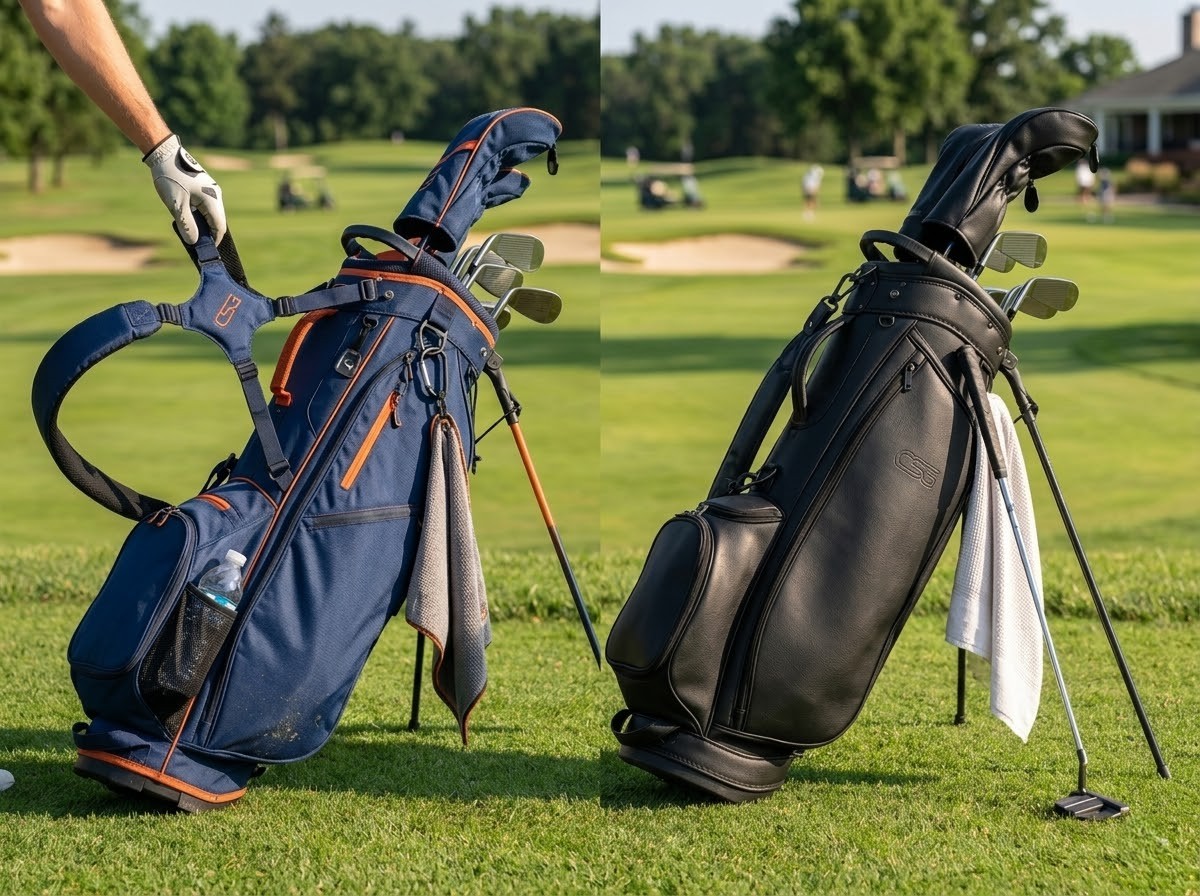
Frequently Asked Questions
1. Is nylon or PU leather more durable for long-term use in golf stand bags?
Durability depends on the environment. In terms of pure structural integrity and resistance to tearing, high-denier nylon (like 1680D) is generally superior and less likely to show structural fatigue over years of heavy use. However, premium PU leather is better at resisting environmental damage like rain and mud stains. At our golf bag factory from China, we find that nylon bags often last longer in “rough” conditions, while PU bags look “newer” for longer if they are properly cared for.
2. Can a custom golf bag manufacturer add waterproof features to a nylon bag?
Yes, absolutely. While nylon is naturally porous, we apply a DWR (Durable Water Repellent) coating to the exterior and a PU or PVC backing to the interior of the fabric. This creates a highly water-resistant barrier. For brands looking for 100% waterproof Golf Stand Bags, we use seam-sealing technology and waterproof zippers, which are standard in high-end OEM golf bag production.
3. Why is the weight difference so significant between these two materials?
It comes down to the density and the construction layers. Nylon is a woven fabric with a high strength-to-weight ratio. PU leather is a composite material consisting of a fabric backing (often polyester), a foam layer for “feel,” and a polyurethane skin. This multi-layer construction makes it much heavier. For wholesale golf stand bags intended for walking golfers, every ounce matters, which is why nylon remains the industry standard for lightweight “carry” bags.
4. Does PU leather peel over time, and how can I prevent this in my production?
Peeling is usually caused by “hydrolysis,” a chemical reaction with moisture. To prevent this, you must ensure your custom golf bag manufacturer uses high-solid, hydrolysis-resistant PU. In our factory, we source materials that are tested for a minimum of 2-year and up to 5-year hydrolysis resistance. Avoid “solvent-based” PU if you are selling in humid or tropical climates, as these are most prone to peeling.
5. How do MOQs differ when choosing between nylon and PU for OEM golf bag production?
Nylon generally offers more flexibility. Because nylon is used in a wide range of industries, many colors are readily available in the market, allowing for lower MOQs (sometimes as low as 100-200 pieces). PU leather is often custom-made for the golf industry. Matching a specific texture or a unique brand color at the material mill usually requires a larger minimum run, which can push the OEM golf bag production MOQ to 300 pieces or more per color.
Partner with Chengsheng Golf, the premier Golf bag factory for brands who demand excellence.
[Contact our engineering team today to map out your 2026-2027 collection timeline.]
References
-
Global Golf Equipment Market Analysis 2025, Golf Datatech, Industry Report.
-
Textile Science for Sporting Goods, Dr. Arash Shahidi, Institute of Materials Science.
-
The Evolution of Synthetic Leathers in Performance Sports, Polyurethane Manufacturers Association (PMA).
-
Standard Test Method for Abrasion Resistance of Textile Fabrics, ASTM International (ASTM D3884).
-
Impact of Bag Weight on Golfer Fatigue and Performance, National Golf Foundation (NGF) Research Division.
-
Sustainability in Sporting Goods Manufacturing, World Federation of the Sporting Goods Industry (WFSGI).
-
REACH and RoHS Compliance in Textile Exports, European Chemicals Agency (ECHA).
-
Advancements in UV Stabilizers for Outdoor Nylon Fabrics, Journal of Industrial Textiles.
Post time: Mar-17-2026