

Quick Summary: The 5-Year Longevity Benchmark
The Material Standard: In the professional market, a Golf Stand Bag achieves the 5-year milestone only through 1680D Ballistic Nylon and lab-tested UV resistance. Using high-denier fabrics is the primary defense against the abrasion and structural thinning that plagues generic 600D alternatives.
The Engineering Core: A durable golf stand bag manufacturer prioritizes aircraft-grade aluminum or carbon fiber legs with 5,000-cycle deployment ratings. These structural hallmarks, combined with reinforced internal dividers, are what differentiate a long-term investment from a two-season “disposable” bag.
The Sourcing Strategy: Partnering with a premium golf bag factory China that integrates YKK #10 zippers and maintains REACH/Prop 65 compliance is no longer optional. For B2B buyers, these technical specifications are the fastest route to reducing return rates and securing brand loyalty in the global market.
The 5-Year Longevity Benchmark: What Defines a Durable Golf Stand Bag
Look, I’ve been in the golf bag manufacturing business for over 30 years. I’ve walked through hundreds of production lines, and I’ve seen thousands of bags returned with broken legs, torn dividers, or zippers that gave up the ghost halfway through a rainy round. In my experience, there is a very clear line in the sand—or rather, on the fairway—that separates a “disposable” bag from a professional-grade piece of equipment. That line is the five-year mark.
Most golfers don’t realize that 80% of the bags on the market today are designed to last maybe two seasons of heavy use. But when we talk about a <strong>durable golf stand bag manufacturer</strong>, we are talking about engineering a product that maintains its structural integrity and aesthetic appeal for at least five years. If you are a sourcing manager or a brand owner, this longevity isn’t just a “nice-to-have” feature; it is the foundation of your brand’s trust. In this deep dive, I’m going to pull back the curtain on what it actually takes to build a bag that survives the 10th hole and the 500th round.

The Anatomy of Durability: Material Science Beyond the Surface
When a client asks me for a high quality golf stand bag wholesale, the first thing I point to isn’t the color or the pockets; it’s the denier of the fabric. Most “budget” bags use 600D polyester. It looks fine in a showroom, but under the harsh UV rays of a summer or the constant friction of a golf cart strap, it thins out and tears within 24 months.
To hit that 5-year benchmark, we primarily look at 1680D Ballistic Nylon or advanced waterproof golf stand bag materials like TPU-coated fabrics. Why does this matter? Denier measures the linear mass density of fibers. A 1680D fabric has nearly triple the abrasion resistance of 600D.
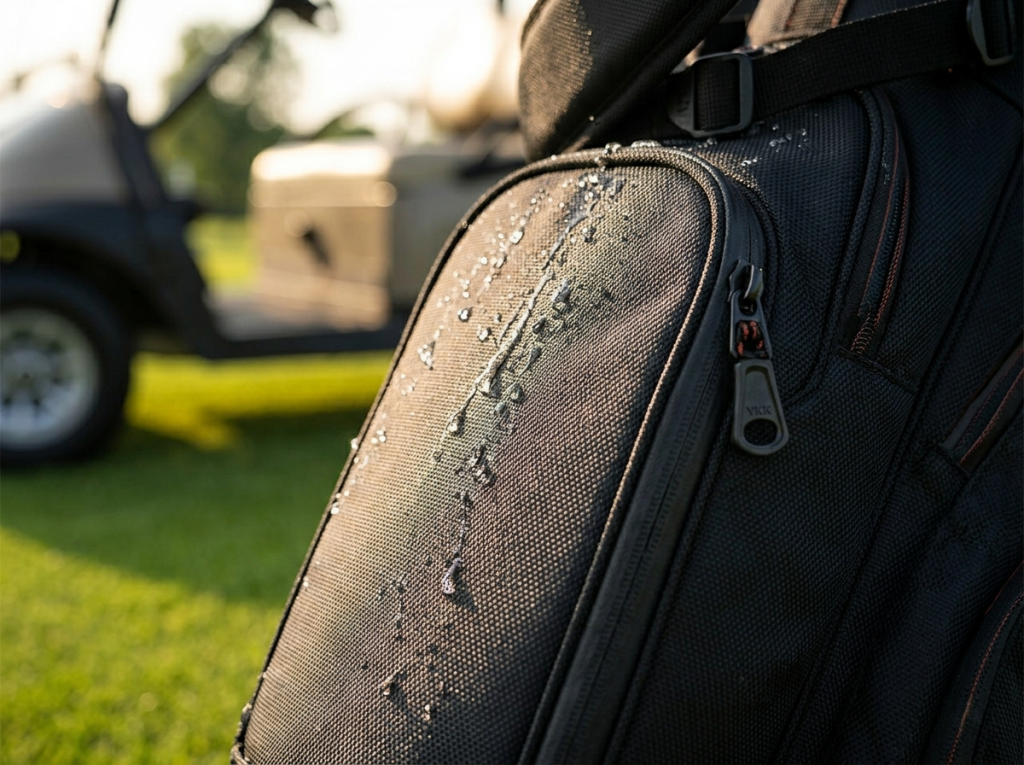
Furthermore, we have to consider UV resistance. In our lab, we perform accelerated weather testing. A standard bag might lose 40% of its tensile strength after 200 hours of direct UV exposure. A premium bag using solution-dyed yarns retains over 90%. This is the difference between a bag that looks “tired” after one season and one that stays vibrant for five years. When you are sourcing from a premium golf bag factory China, you must demand these material certifications to ensure your customers aren’t left with a faded, brittle product.
The Backbone of the Bag: Engineering the Stand Mechanism
The “stand” is the most vulnerable part of any Golf Stand Bag. I can’t tell you how many times I’ve seen a player’s day ruined because a leg snapped or the tension spring lost its “pop.” A bag that lasts five years requires a stand mechanism engineered for at least 5,000 to 7,000 cycles of deployment.
In high-end manufacturing, we’ve moved away from heavy, brittle plastics toward glass-filled nylon for the hinges and aircraft-grade aluminum or carbon fiber for the legs. Carbon fiber is particularly interesting for a lightweight golf stand bag for walking. It offers a higher strength-to-weight ratio than aluminum and doesn’t bend permanently if someone accidentally leans on it.
The “actuator”—the little foot that triggers the legs when you set the bag down—needs to be made of a high-impact polymer. We often see cheap “wholesale” bags using recycled plastics here that crack in cold weather. A 5-year bag uses virgin materials that remain flexible at -10°C and rigid at 40°C. This is the “hidden” engineering that a customized golf stand bags from a factory expert will always emphasize.
Interior Architecture: 14-Way vs 4-Way Dividers
There is a constant debate in the clubhouse: “Should I go with a 14-way or a 4-way top?” From a manufacturing durability perspective, the answer is more complex than just club organization.
A 14-way divider golf bag durability study shows that while these bags offer better club protection, they also introduce more “failure points” if the internal stitching is subpar. For a bag to last five years, these dividers must be “full-length.” This means the fabric goes all the way from the top to the base.
Without full-length dividers, your club grips will tangle and rub against the internal fabric, eventually tearing the lining. We use a reinforced mesh or a smooth, high-denier polyester for the lining to ensure that even after 500 rounds of sliding clubs in and out, the interior remains intact. If you are looking for wholesale golf bags with stands, always stick your hand down into the bag to feel if those dividers are truly anchored at the bottom.
Ergonomics and Carrying Comfort: The Role of Dual Straps
If a bag is uncomfortable, a golfer will replace it long before the materials wear out. To reach the 5-year goal, the carrying system must be both durable and ergonomic.
For a lightweight golf stand bag for walking, we utilize high-density EVA foam in the straps. Cheap open-cell foam (the kind you find in packing material) compresses and loses its shape after 20 rounds, leaving the golfer with thin, “digging” straps. EVA foam, however, has a memory-like quality and can withstand thousands of hours of pressure without thinning.
The attachment points—the D-rings and swivel buckles—are another critical failure point. In our custom golf bag OEM service, we insist on using heavy-duty nylon hardware or powder-coated metal. We double-stitch or “box-stitch” the attachment zones to ensure the strap never rips away from the main body, even when the bag is fully loaded with clubs, balls, and a full water bottle.
Data Insight: High-End vs. Budget Stand Bags Comparison Table
To give you a clearer picture of what makes a bag “5-year ready,” look at the technical specifications we use during the quality control process.
| Feature | Budget Stand Bag (1-2 Years) | Premium Stand Bag (5+ Years) |
| Main Fabric | 600D Polyester | 1680D Ballistic Nylon / TPU |
| Zipper Type | Generic #5 Plastic | YKK #8 or #10 Water-resistant |
| Leg Material | Low-grade Aluminum | Carbon Fiber / Aircraft Aluminum |
| Stitch Count | 6-7 Stitches per inch | 10-12 Stitches per inch |
| UV Resistance | < 200 Hours | > 1000 Hours (Color Fastness) |
| Base Material | Recycled PP | High-impact Virgin Polypropylene |
| Internal Dividers | Partial / Non-reinforced | Full-length / Reinforced Mesh |
Manufacturing Excellence: Identifying a Premium Golf Bag Factory in China

For the B2B buyer, the challenge isn’t just finding a bag; it’s finding the right premium golf bag factory China. You need a partner who understands that “quality” is a process, not a label.
A top-tier factory will have a robust Quality Management System (QMS). When I walk through a facility, I look for ISO 9001 certification and BSCI (Business Social Compliance Initiative) audits. But beyond the paperwork, I look for the testing lab. Does the factory have a “salt spray” chamber to test for rivet corrosion? Do they have a “pull-test” machine to verify the strength of the handles?
When you engage in a custom golf bag OEM service, your manufacturer should be able to provide “Protolabs” or sample reports that detail the failure limits of every component. If a factory tells you “it’s all good” without showing you a data sheet, that’s a red flag. A 5-year bag is built on data, not promises.
Regional Trends and Regulations in Golf Gear Manufacturing
The global market is shifting. It’s no longer just about durability; it’s about “clean” durability. Buyers in Europe and North America are increasingly looking for high quality golf stand bag wholesale options that comply with strict environmental regulations.
We are seeing a massive trend toward GRS (Global Recycled Standard) certified fabrics. Using recycled polyester made from ocean-bound plastics is now a viable way to produce a durable golf stand bag manufacturer‘s product without sacrificing strength. Furthermore, compliance with REACH (Registration, Evaluation, Authorisation, and Restriction of Chemicals) and California’s Proposition 65 is non-negotiable.
If your bag contains lead in the zippers or phthalates in the PVC trim, it won’t just fail the 5-year durability test; it will fail the customs inspection. A professional factory ensures that every rivet, ink, and fabric coating is compliant with these global standards.
Common Failures and How to Avoid Them: The Expert’s Checklist
After 30 years, I’ve developed a “cheat sheet” for identifying a bag that’s going to fail early. If you are inspecting a sample of a Golf Stand Bag, check these three things:
-
The Zipper Garage: Does the zipper have a “hood” at the top? Without it, water will seep into the teeth, leading to oxidation and eventual jam-ups.
-
The Base Attachment: Is the fabric glued or stitched to the plastic base? A 5-year bag is always stitched and often reinforced with rivets. Glue fails in the heat; stitches don’t.
-
The Rivet Quality: Are the rivets flush and smooth? If they are jagged or use cheap steel, they will rust and stain the fabric, or worse, snag the golfer’s expensive polo shirt.
When you buy customized golf stand bags from a factory, these small details are what prevent a 10% return rate. A 1% return rate is the goal of any serious brand.
Conclusion: Investing in Quality for Long-term Brand Success
At the end of the day, a Golf Stand Bag is more than just a container for clubs; it is a companion for the golfer and a billboard for your brand. If that bag lasts five years, that golfer will return to your brand for their next three bags. If it breaks in year one, you’ve lost a customer for life.
As an industry veteran, my advice is simple: don’t cut corners on the things that “hold” the bag together—the legs, the straps, and the zippers. Focus on sourcing from a premium golf bag factory China that values engineering over aesthetics. Quality is what happens when the manufacturer cares just as much about the internal stitching as they do about the external logo.
Building a bag that meets the 5-year longevity benchmark is hard work. It requires better materials, slower production lines, and rigorous testing. But in a world full of disposable products, a truly durable bag is the ultimate competitive advantage.
5 Frequently Asked Questions About Golf Stand Bags
1. What is the most durable material for a golf stand bag intended for heavy use?
For maximum longevity, 1680D Ballistic Nylon or high-grade TPU-coated fabrics are the industry gold standard. These materials offer superior abrasion resistance and UV protection compared to standard 600D polyester. When sourcing from a durable golf stand bag manufacturer, always check the “denier” count and the water-resistance rating (typically measured in mm of water pressure) to ensure the fabric can withstand multiple seasons of outdoor exposure.
2. How can I tell if a golf bag manufacturer in China is high-quality?
A premium golf bag factory China will have international certifications like ISO 9001 and BSCI. More importantly, they should have an in-house testing facility where they perform stress tests on zippers, leg mechanisms, and fabric colorfastness. Always ask for a “Product Specification Sheet” that lists the brand of zippers (such as YKK) and the specific grade of aluminum or carbon fiber used for the stand legs before placing a wholesale golf bags with stands order.
3. Why do the legs on some stand bags fail so quickly?
Leg failure is usually caused by either poor material choice (recycled plastic hinges) or an inadequate tension spring. High-quality bags use “Aircraft-grade Aluminum” or “Carbon Fiber” for the legs because these materials resist bending. The actuator (the part that touches the ground) must be made of high-impact nylon to prevent cracking. A bag built for a 5-year lifespan should be tested for at least 5,000 deployment cycles.
4. Is a 14-way divider bag more durable than a 4-way or 5-way bag?
A 14-way divider provides better organization and prevents club-on-club friction, which protects your equipment. However, from a bag construction standpoint, it requires more internal stitching. To ensure 14-way divider golf bag durability, the dividers must be “full-length” and made of high-denier reinforced fabric. This prevents the internal walls from tearing over time as clubs are repeatedly inserted and removed.
5. What are the benefits of ordering customized golf bags directly from a factory?
Using a custom golf bag OEM service allows you to control every aspect of the bag’s quality, from the thickness of the EVA foam in the straps to the specific type of rust-proof rivets used. This is essential for B2B buyers who need to ensure their products meet regional regulations like REACH or Prop 65. Directly working with the factory also allows for “low MOQ” customization while maintaining a much higher quality-to-price ratio than buying generic off-the-shelf products.
[Contact our engineering team today to review your tech pack and plan your all-weather collection.]
Post time: Mar-31-2026